
3D Object Retrieval
3D object retrieval applications can be classified into two major categories: interclass and intraclass retrieval. Interclass retrieval focuses on a generic domain of 3D objects and aims at finding the closest match among a set of 3D models that belong to a broad range of different classes. In this case, there is usually no prior knowledge regarding the characteristics or the nature of the 3D objects. Intraclass retrieval targets a specific 3D object domain (e.g. 3D faces, non-rigid 3D models, human action models, engineering models etc.), where a match is sought between 3D models that belong to the same class but have their special characteristics defined differently. Intraclass 3D object retrieval methods usually exploit domain knowledge and shape characteristics of the 3D models, in order to attain higher performance.
For both categories, the generic framework of a 3D object retrieval system can be outlined as follows: preprocessing, pose normalization, shape descriptor extraction, feature matching.
Partial 3D Object Retrieval
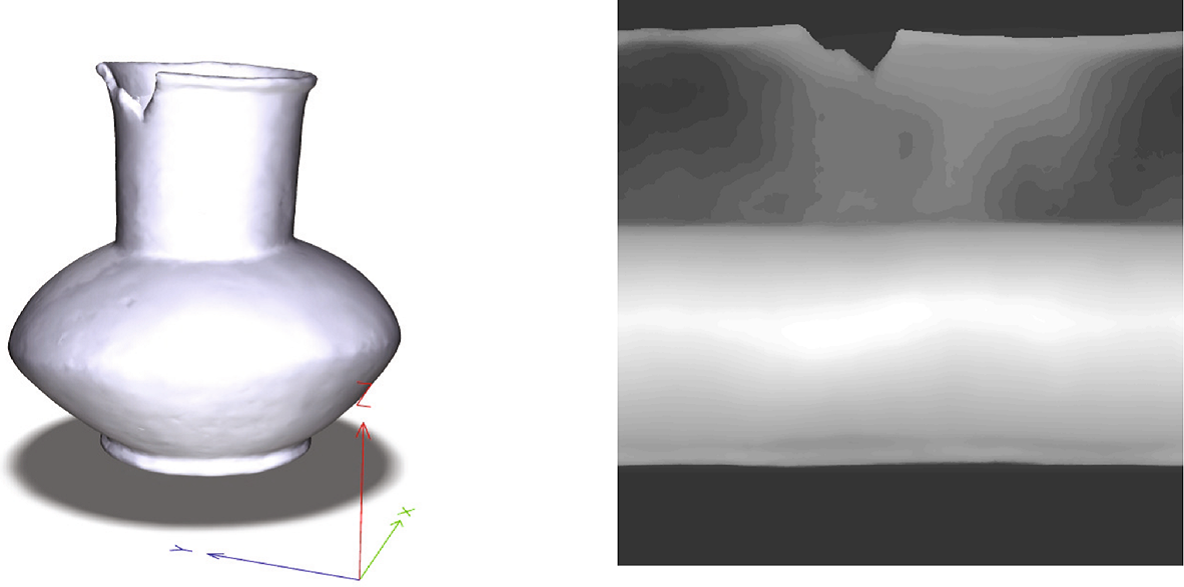
We present a method for partial matching and retrieval of 3D objects based on range image queries. The proposed methodology addresses the retrieval of complete 3D objects using range image queries that represent partial views. The core methodology relies upon Bag-of-Visual-Words modelling and enhanced Dense SIFT descriptor computed on panoramic views and range image queries. Performance evaluation builds upon standard measures and a challenging 3D pottery dataset originating from the Hampson Archaeological Museum collection.
Related Publications
- K. Sfikas, I. Pratikakis, A. Koutsoudis, M. Savelonas and T. Theoharis, “Partial Matching of 3D Cultural Heritage Objects using Panoramic Views”, Multimedia Tools and Applications, 2014.
- K. Sfikas, I. Pratikakis, A. Koutsoudis, M.A. Savelonas, T. Theoharis, “3D Object Partial Matching Using Panoramic Views”, ICIAP Workshops, (169-178), 2013.
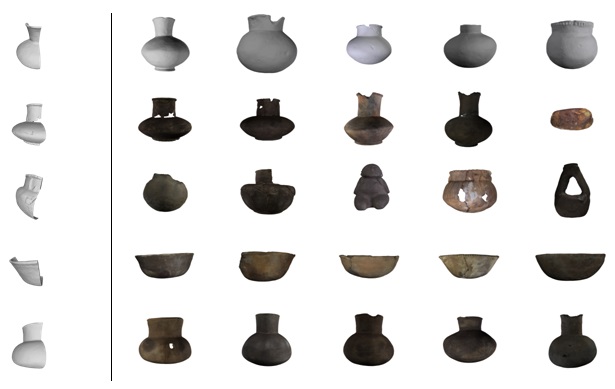
We introduce a method for the retrieval of 3D pottery objects, based on partial point cloud queries. The proposed method extracts fast persistent feature histograms calculated adaptively to the mean point distances of the point cloud query. The extracted set of vectors is refined by a denoising component, which employs statistical filtering. The remaining vectors are further refined by a filtering component, which discards points surrounded by surfaces of extremely fine-grained irregularity, often associated with artefact damages. A bag of visual words scheme is used, which starts from the final set of persistent feature histogram vectors and estimates Gaussian mixture models by means of an expectation maximization algorithm.
The resulting Gaussian mixture models define the visual codebook, which is used within the context of Fisher encoding. Experiments are performed on a challenging dataset of pottery objects, obtained from the publicly available Hampson collection.
Related Publications
- M. Savelonas, I. Pratikakis and K. Sfikas, “Fisher Encoding of Adaptive Fast Persistent Feature Histograms for Partial Retrieval of 3D Pottery Objects”, Eurographics Workshop on 3D Object Retrieval, (61 - 68), 2014.
Rigid 3D Object Retrieval
Pose Normalization
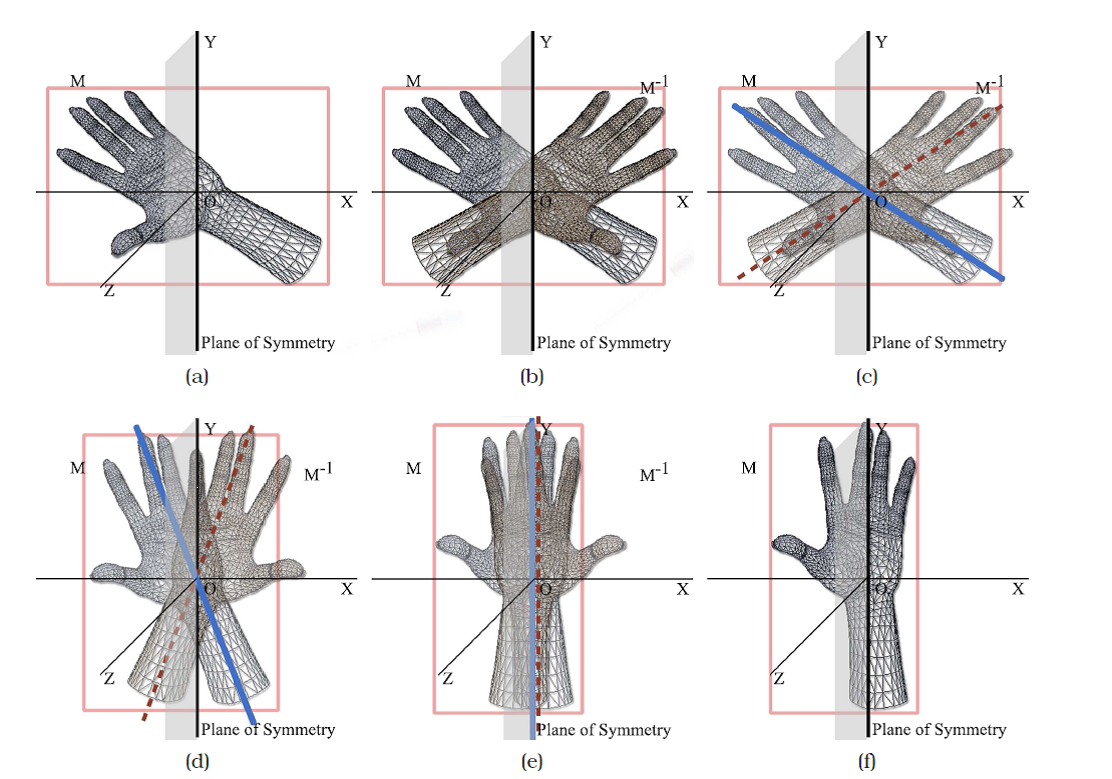
ROSy: A general purpose global pose normalization method based on 3D object reflective symmetry. Initially, the axis-aligned minimum bounding box of a rigid 3D model is modified by requiring that the 3D model is also in minimum angular difference with respect to the normals to the faces of its bounding box. To estimate the modified axis-aligned bounding box, a set of predefined planes of symmetry are used and a combined spatial and angular distance, between the 3D model and its symmetric model, is calculated. By minimizing the combined distance, the 3D model fits inside its modified axis-aligned bounding box and alignment with the coordinate system is achieved.
Related Publications
- K Sfikas, T Theoharis, I Pratikakis, “ROSy+: 3D object pose normalization based on PCA and reflective object symmetry with application in 3D object retrieval”, International Journal of Computer Vision 91 (3), 262-279
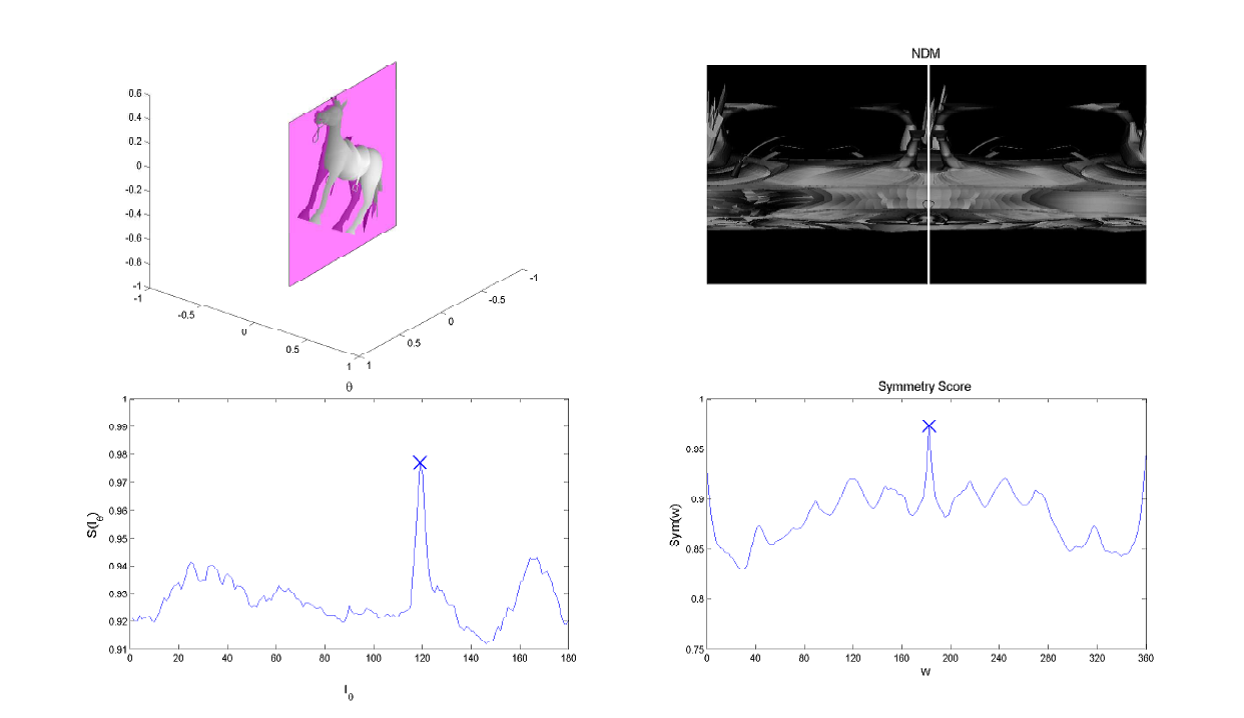
SymPan+: A pose normalization method based on similar principles as the SymPan methodology. Qualitative and experimental investigation in 3D datasets has led us to the observation that most objects possess a single plane of symmetry. Our approach is thus guided by this observation. Initially, through an iterative procedure, the symmetry plane of a 3D model is estimated, thus computing the first axis of the model. This is achieved by rotating the 3D model and computing reflective symmetry scores on panoramic view images. The other principal axes of the 3D model are estimated by computing the variance of the 3D model’s panoramic views.
Related Publications
- K Sfikas, I Pratikakis, T Theoharis, “Sympan: 3D model pose normalization via panoramic views and reflective symmetry”, Proceedings of the Sixth Eurographics Workshop on 3D Object Retrieval 41-48
- K Sfikas, T Theoharis, I Pratikakis, “Pose normalization of 3D models via reflective symmetry on panoramic views”, The Visual Computer, 1-14
3D Shape Descriptors
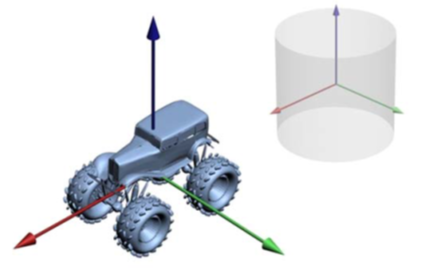
We present a novel 3D shape descriptor that uses a set of panoramic views of a 3D object which describe the position and orientation of the object’s surface in 3D space. We obtain a panoramic view of a 3D object by projecting it to the lateral surface of a cylinder parallel to one of its three principal axes and centered at the centroid of the object. The object is projected to three perpendicular cylinders, each one aligned with one of its principal axes in order to capture the global shape of the object. For each projection we compute the corresponding 2D Discrete Fourier Transform as well as 2D Discrete Wavelet Transform. We further increase the retrieval performance by employing a local (unsupervised) relevance feedback technique that shifts the descriptor of an object closer to its cluster centroid in feature space. The effectiveness of the proposed 3D object retrieval methodology is demonstrated via an extensive consistent evaluation in standard benchmarks that clearly shows better performance against state-of-the-art 3D object retrieval methods.
Related Publications
- P. Papadakis, I. Pratikakis, T. Theoharis, S. Perantonis, “PANORAMA: A 3D Shape Descriptor based on Panoramic Views for Unsupervised 3D Object Retrieval”, International Journal of Computer Vision, Special Issue on: 3D Object Retrieval, 89, 2, 2010, pp. 177-192
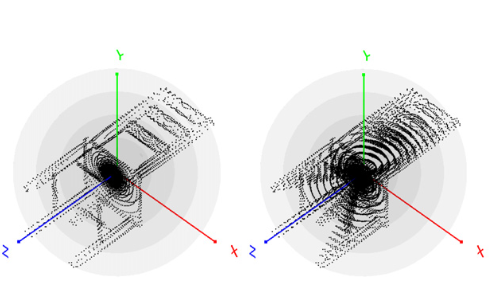
We present a 3D shape retrieval methodology based on the theory of spherical harmonics. Using properties of spherical harmonics, scaling and axial flipping invariance is achieved. Rotation normalization is performed by employing the continuous principal component analysis along with a novel approach which applies PCA on the face normals of the model. The 3D model is decomposed into a set of spherical functions which represents not only the intersections of the corresponding surface with rays emanating from the origin but also points in the direction of each ray which are closer to the origin than the furthest intersection point. The superior performance of the proposed methodology is demonstrated through a comparison against state-of-the-art approaches on standard databases.
Related Publications
- P. Papadakis, I. Pratikakis, S. Perantonis, T. Theoharis, “Efficient 3D Shape Matching and Retrieval using a Concrete Radialized Spherical Projection Representation”, Pattern Recognition, 40, 9 (2007), pp. 2437-2452
Range Image based Rigid 3D Object Retrieval
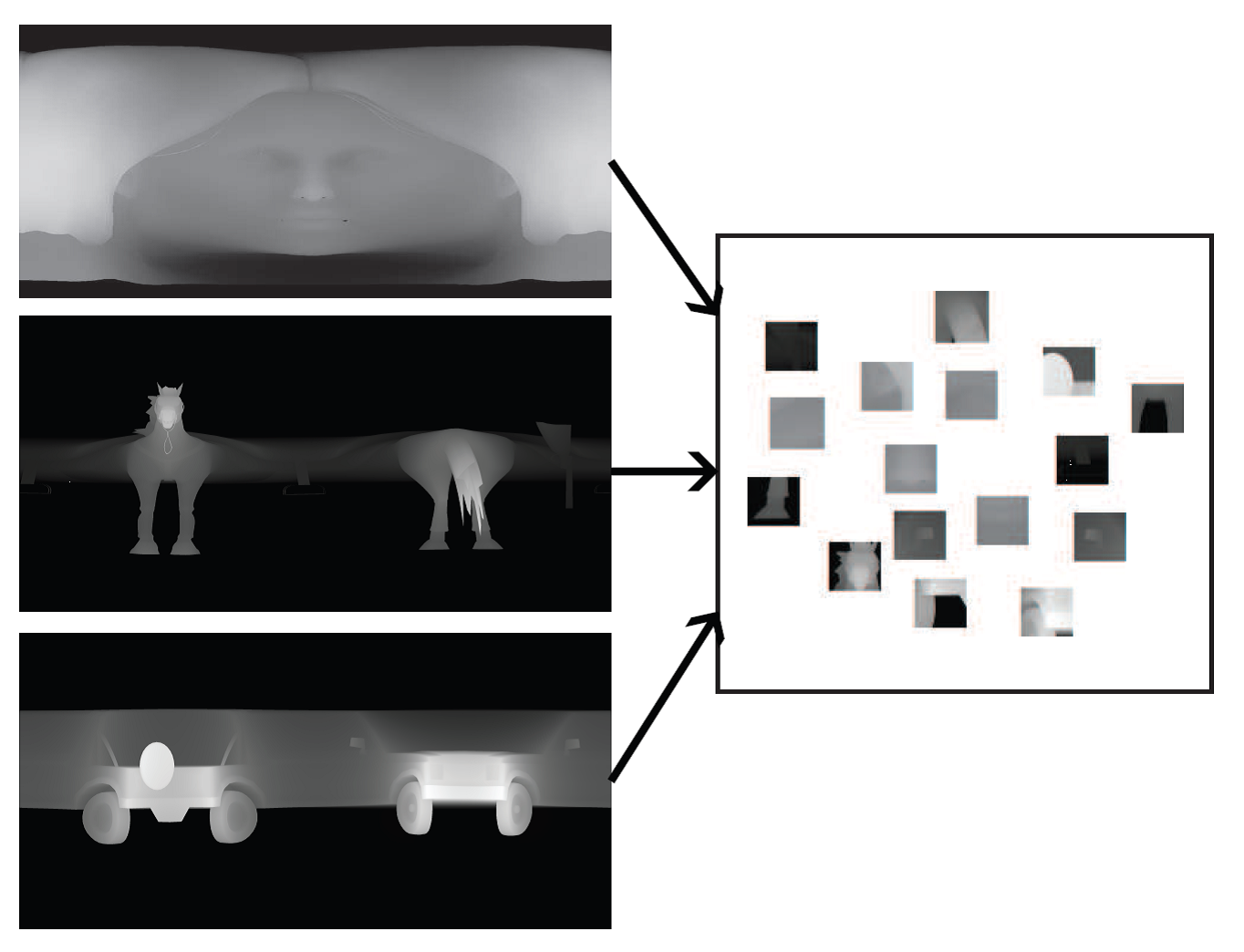
A 3D object retrieval method, based on range image queries that represent partial views of real 3D objects, is presented. The complete 3D models of the database are described by a set of panoramic views and a Bag-of-Visual-Words model is built using SIFT features extracted from them. To address the problem of partial matching, a histogram computation scheme, on the panoramic views, that represents local information by taking into account spatial context, is suggested. Furthermore, a number of optimization techniques are applied throughout the process, for enhancing the retrieval performance.
Related Publications
- K Sfikas, I Pratikakis, A Koutsoudis, M Savelonas, T Theoharis, “3D object partial matching using panoramic views”, New Trends in Image Analysis and Processing–ICIAP 2013, 169-178
- K Sfikas, I Pratikakis, T Theoharis, “3D object retrieval via range image queries based on SIFT descriptors on panoramic views”, Proceedings of the 5th Eurographics conference on 3D Object Retrieval, 9-15
- K Sfikas, T Theoharis, I Pratikakis, “3D object retrieval via range image queries in a bag-of-visual-words context”, The Visual Computer 29 (12), 1351-1361
Non-Rigid 3D Object Retrieval
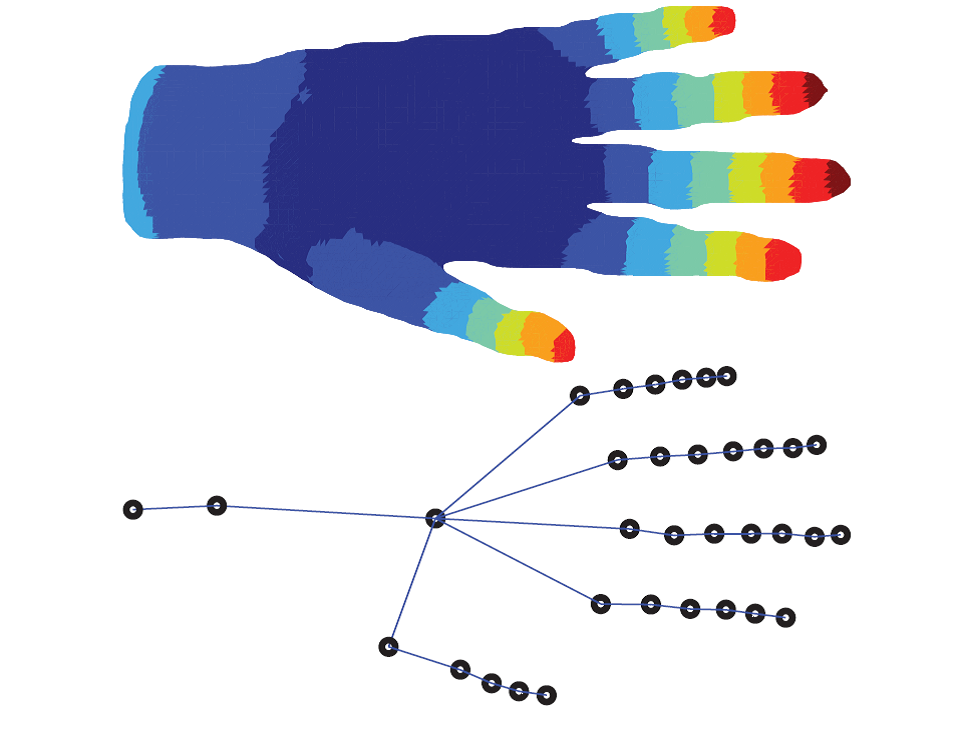
ConTopo: Combining the properties of conformal geometry and graph-based topological information, a non-rigid 3D object retrieval methodology is proposed, which is both robust and efficient in terms of retrieval accuracy and computation speed. While graph-based methods are robust to non-rigid object deformations, they require intensive computation which can be reduced by the use of appropriate representations, addressed through geometry-based methods. In this respect, a 3D object retrieval methodology, which combines the above advantages in a unified manner, is presented. Furthermore, a string matching strategy for the comparison of graphs which describe 3D objects, is proposed.
Related Publications
- K Sfikas, T Theoharis, I Pratikakis, “Non-rigid 3D object retrieval using topological information guided by conformal factors”, The Visual Computer 28 (9), 943-955.
- K Sfikas, I Pratikakis, T Theoharis, “ConTopo: Non-Rigid 3D Object Retrieval using Topological Information guided by Conformal Factors”, 3DOR 11, 25-32
3D Object Segmentation
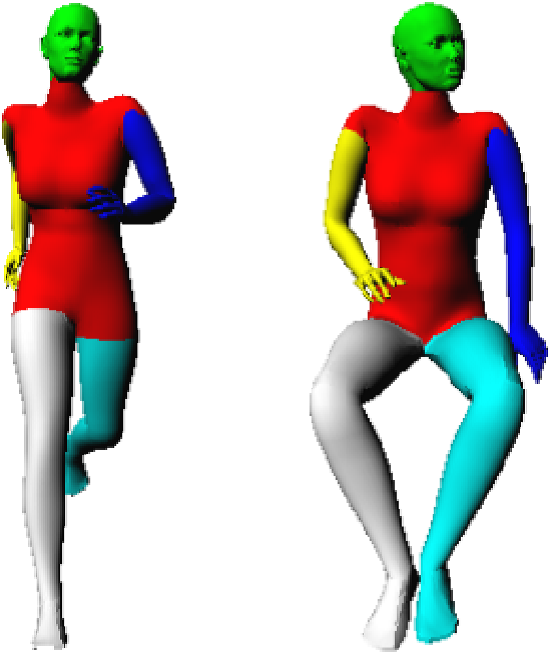
In this paper, we present a segmentation algorithm which partitions a mesh based on the premise that a 3D object consists of a core body and its constituent protrusible parts. Our approach is based on prominent feature extraction and core approximation and segments the mesh into perceptually meaningful components. Based upon the aforementioned premise, we present a methodology to compute the prominent features of the mesh, to approximate the core of the mesh and finally to trace the partitioning boundaries which will be further refined using a minimum cut algorithm. Although the proposed methodology is aligned with a general framework introduced by Lin et al. (IEEE Trans. Multimedia 9(1):46–57, 2007), new approaches have been introduced for the implementation of distinct stages of the framework leading to improved efficiency and robustness. The evaluation of the proposed algorithm is addressed in a consistent framework wherein a comparison with the state of the art is performed.
Related Publications
- A Agathos, I Pratikakis, S Perantonis, NS Sapidis, “Protrusion-oriented 3D mesh segmentation”, The Visual Computer 26 (1), 63-81
- A Agathos, I Pratikakis, S Perantonis, N Sapidis, P Azariadis, “3D mesh segmentation methodologies for CAD applications”, Computer-Aided Design and Applications 4 (6), 827-841
Part-Based Retrieval
Most of the approaches which address the problem of 3D object retrieval, use global descriptors of the objects which fail to consistently compensate for the intra-class variability of articulated objects. In this paper, a retrieval methodology is presented which is based upon a graph-based object representation. This is composed of a meaningful new mesh segmentation along with a graph matching between the graph of the query object and each of the graphs that correspond to the objects of the 3D object database. The graph matching algorithm is based on the Earth Mover’s Distance (EMD) similarity measure which is calculated using a new ground distance assignment. The superior performance of the proposed methodology is shown after an extensive experimentation comprising alternative descriptors for the constituent components of the 3D object as well as comparison with state of the art retrieval algorithms.
Related Publications
- A Agathos, I Pratikakis, P Papadakis, S Perantonis, P Azariadis, “3D articulated object retrieval using a graph-based representation”, The Visual Computer 26 (10), 1301-1319
- A Agathos, I Pratikakis, P Papadakis, S Perantonis, P Azariadis, N Sapidis, “Retrieval of 3D articulated objects using a graph-based representation”, Proceedings of the 2nd Eurographics conference on 3D Object Retrieval, 29-36
