For autonomous driving, a common practice is to design the software stack of an autonomous vehicle by grouping the individual sub-components into three main modules: perception, planning and control. Perception refers to the ability of an autonomous vehicle to perceive its surrounding area by identifying and detecting the road infrastructure along with road users. A perception system should provide accurate, robust and reliable information concerning the environment around the autonomous vehicle, in real-time. Such a system usually consists of many different complementary sensors, out of which cameras and Light Detection And Ranging (LiDAR) sensors are the two most common ones.
LiDAR–camera extrinsic calibration
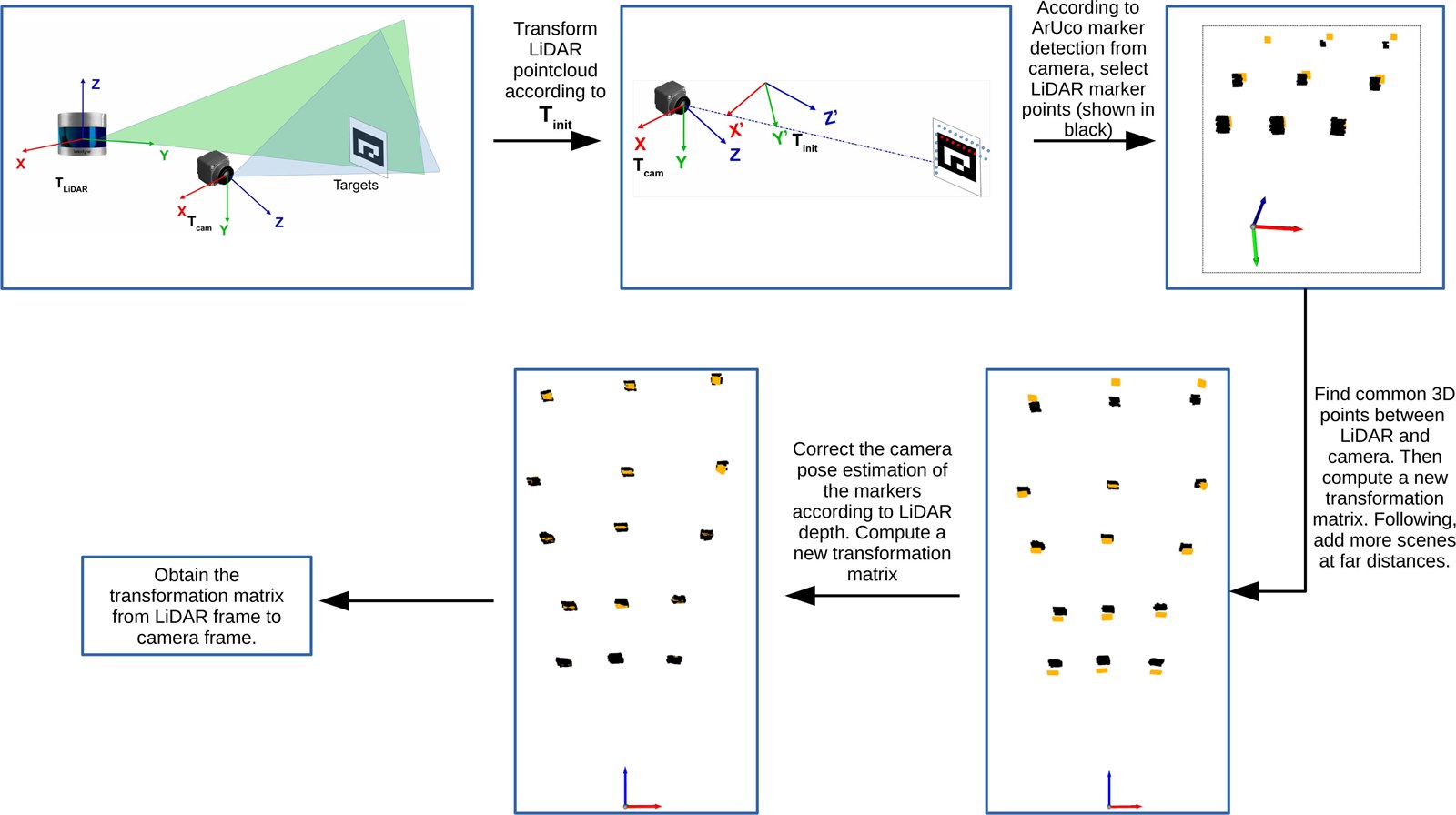
We present a methodology for LiDAR–camera extrinsic calibration that detects special ArUco markers by processing multiple scenes from both sensor modalities. For each scene, the ArUco markers are placed on different locations of varied depths. The core methodology performs the detection of ArUco markers on both LiDAR point cloud and camera image frame and utilizes a LiDAR/camera cooperative scheme to further improve the quality of the marker detection, thus improving the estimation of the extrinsic parameters.
Related publicationG. Zamanakos, L. Tsochatzidis, A. Amanatiadis and I. Pratikakis, “A cooperative LiDAR-camera scheme for extrinsic calibration,” 2022 IEEE 14th Image, Video, and Multidimensional Signal Processing Workshop (IVMSP), 2022, pp. 1–5.
LiDAR-based 3D object detection
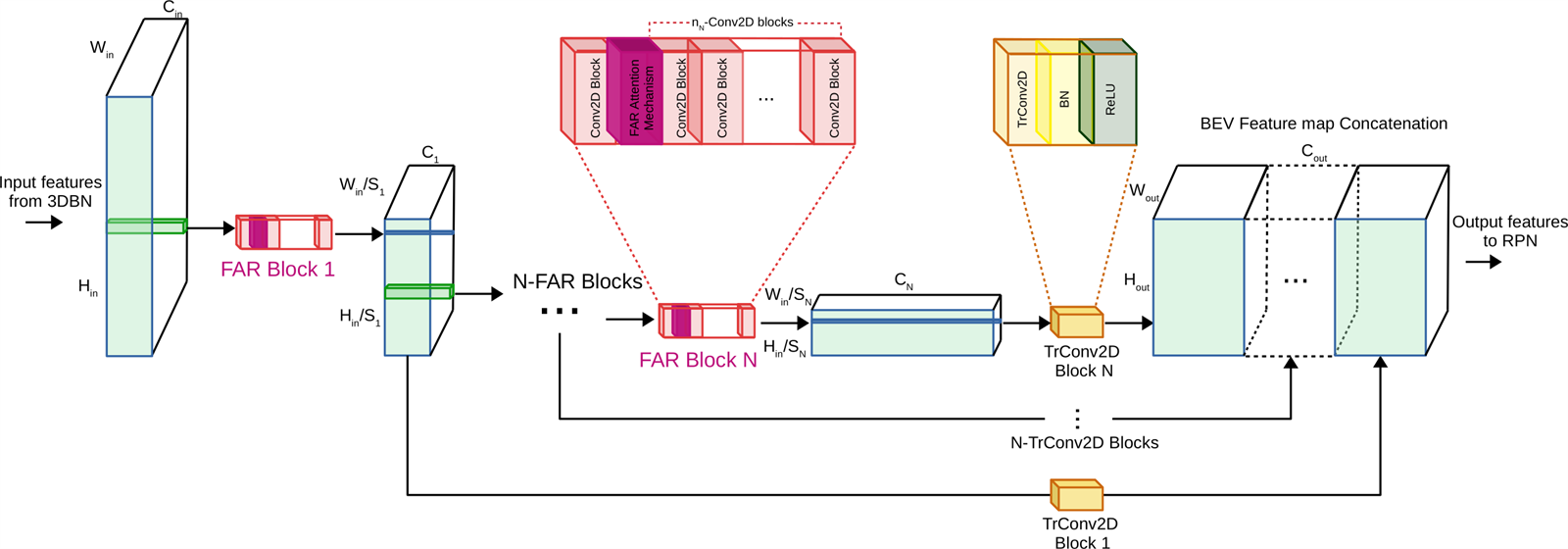
The proposed approach is based on LiDAR-based 3D object detection. It aims to detect objects of variable classes in 3D space, by predicting the location, dimension and orientation of a 3D Bounding Box that encloses each object tightly. The contribution of the proposed methodology is a novel and modular 2D Backbone network for feature extraction in Bird’s Eye View (BEV), namely the Feature Aware Re-weighting (FAR) Network, which uses a specially designed attention mechanism to improve the detection quality of LiDAR-based 3D object detectors.
Related publicationG. Zamanakos, L. Tsochatzidis, A. Amanatiadis and I. Pratikakis, “Feature Aware Re-weighting (FAR) in Bird’s Eye View for LiDAR-based 3D object detection in autonomous driving applications,” Robotics and Autonomous Systems, vol. 175, 104664, 2024.
3D semantic segmentation
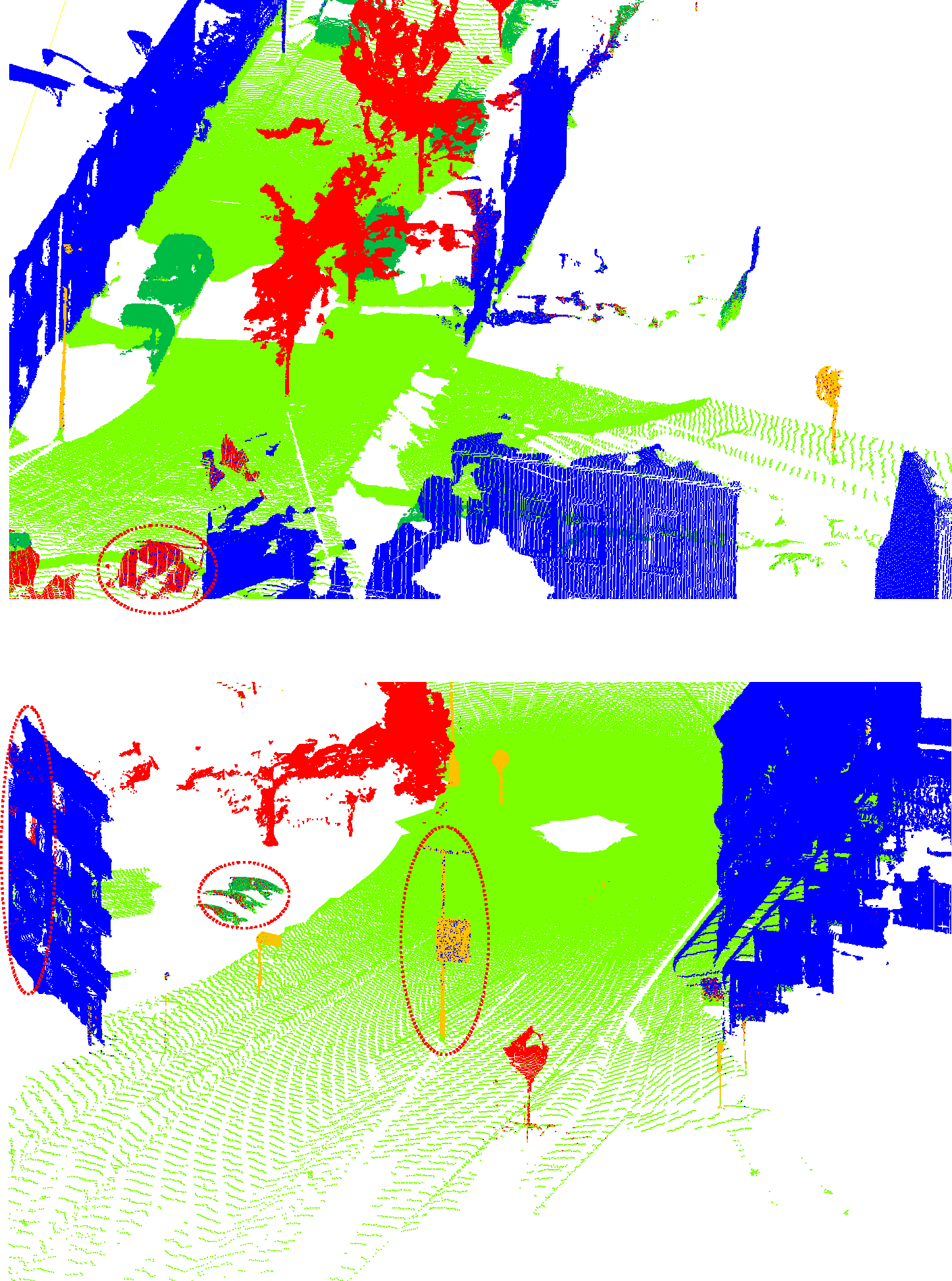
The proposed approach is based on LiDAR-based 3D semantic segmentation for autonomous driving and 3D scene understanding, where the corresponding point clouds should be labeled with semantics. The contribution of the proposed methodology is to determine not only which types of attention mechanisms are most effective for the task of 3D semantic segmentation, but also to determine the most efficient way to incorporate them in the architecture of existing 3D Backbone networks.
Related publicationV. Vanian, G. Zamanakos and I. Pratikakis, “Improving performance of deep learning models for 3D point cloud semantic segmentation via attention mechanisms,” Computers & Graphics, vol. 106, pp. 277–287, 2022.
Multi-task learning — dual-task semantic segmentation
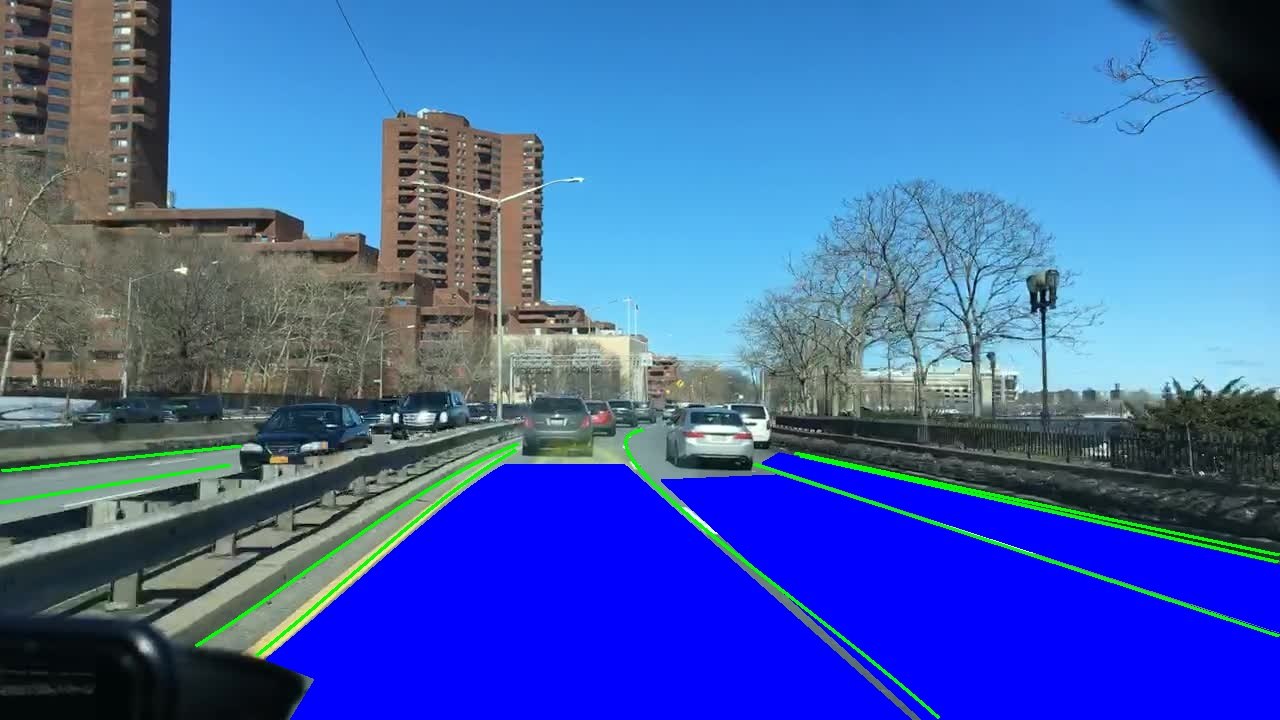
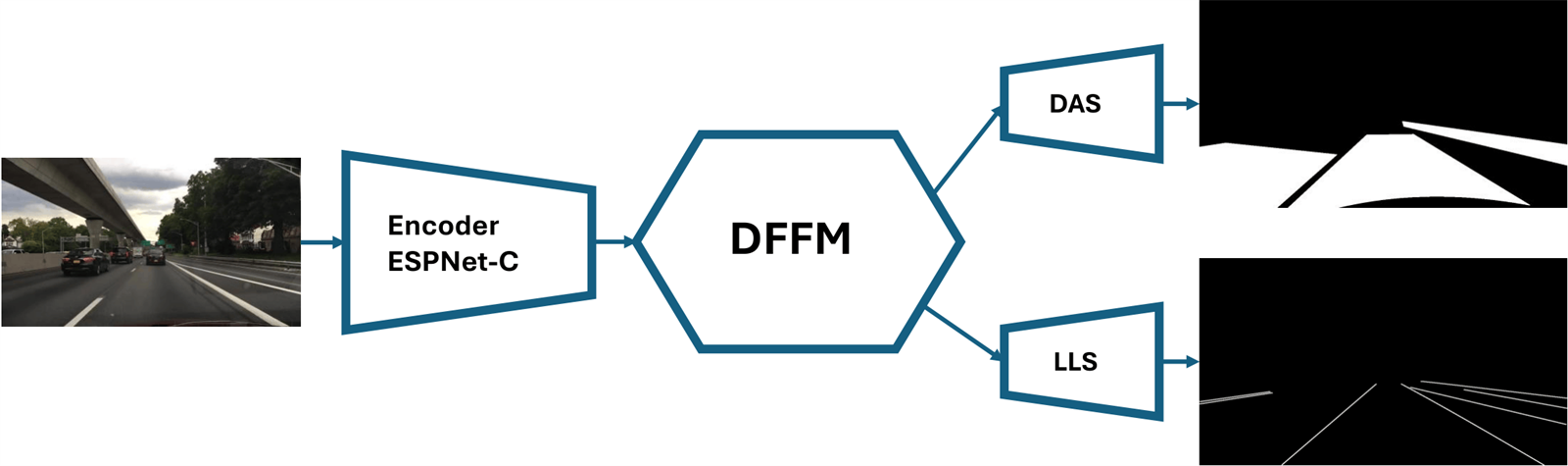
We propose a dual-task model designed for semantic segmentation tasks in the field of autonomous driving, i.e. drivable area segmentation and lane line segmentation, emphasizing in a lightweight architecture and real-time performance aiming to give solutions for resource-constrained embedded devices in real-world applications. The contribution of the proposed method is a lightweight architecture that is built in a multi-task fashion and relies upon a multi-task decoder that enhances the extracted features from the encoder, while refining specific features for each task aiming to reduce negative transfer.
Related publicationI. Papadeas, L. Tsochatzidis and I. Pratikakis, “Dual-Task Learning for Real-Time Semantic Segmentation in Autonomous Driving,” IEEE Transactions on Intelligent Vehicles, vol. 11, no. 1, pp. 94–103, Jan. 2026, doi: 10.1109/TIV.2025.3579878.
Continual test-time domain adaptation for object detection
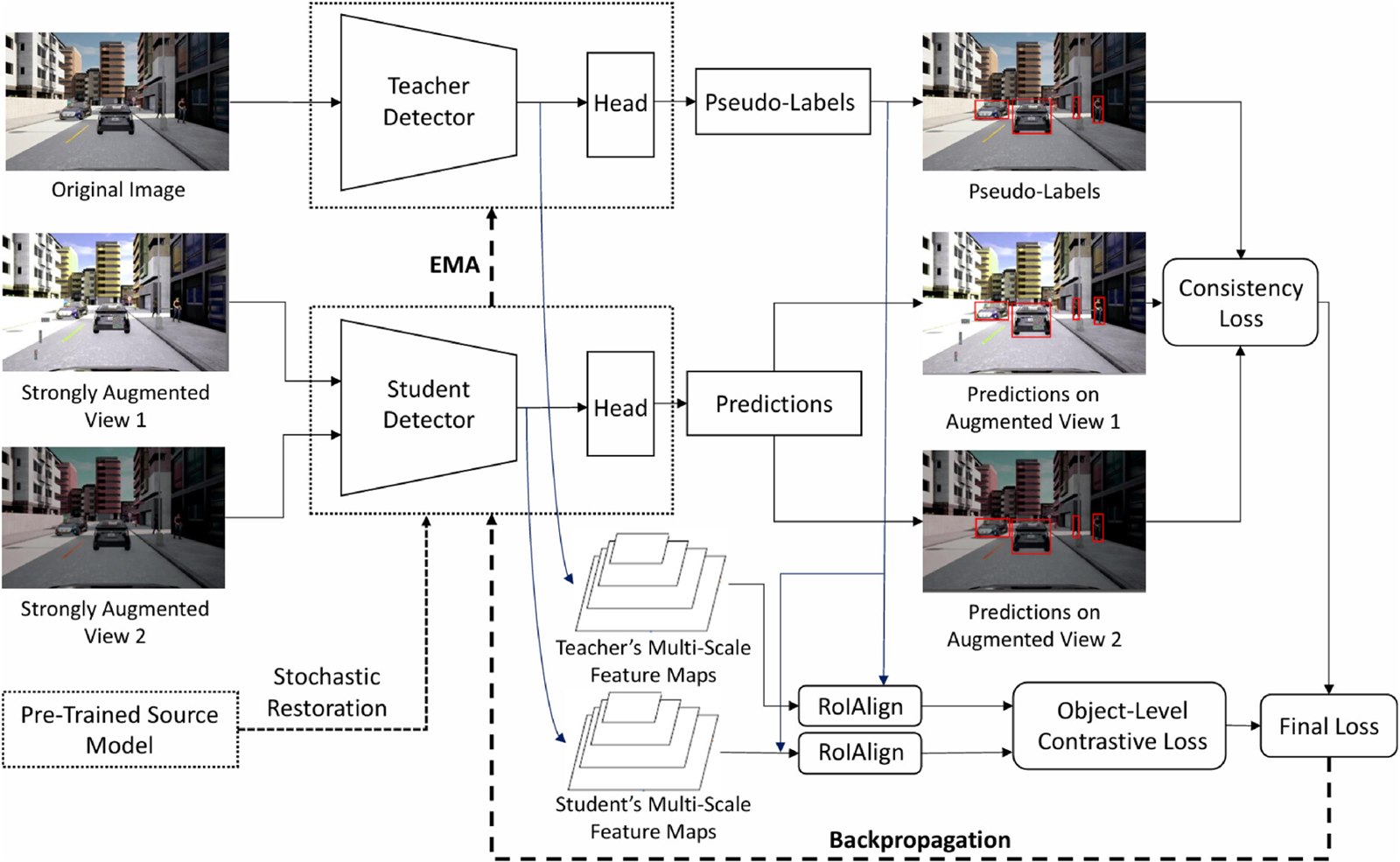
The proposed approach is based on continual test-time adaptation for object detection, where a pre-trained object detector should adapt during inference to a non-stationary target domain without using labels or source-domain data. The contribution of the proposed methodology is to improve the robustness and performance of mean teacher-based adaptation by integrating object-level contrastive learning with stochastic restoration, aiming to reduce the effect of noisy pseudo-labels and prevent catastrophic forgetting during long-term adaptation. More specifically, the method applies this framework to a one-stage object detector, YOLOX, demonstrating that competitive performance can be achieved in a source-free setting while effectively handling continuously changing domain shifts in real-world conditions.
Related publicationP. Moraiti, I. Papadeas, L. Tsochatzidis and I. Pratikakis, “Continual Test-Time Domain Adaptation for Object Detection via Contrastive Mean Teacher and Stochastic Restoration,” The European Journal on Artificial Intelligence, vol. 39, no. 2, pp. 270–287, 2026, doi: 10.1177/30504554251394323.